Digital Product Business in 2026: Advanced Strategies to Build and Scale Online
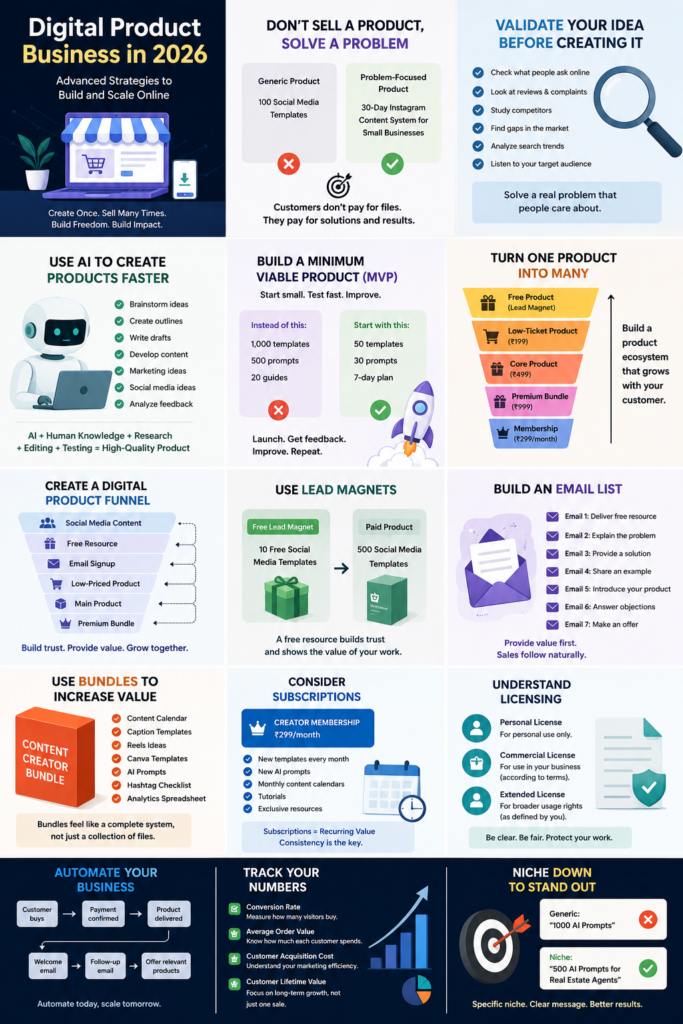
The digital product industry has changed significantly. Creating an ebook, template or online course is easier than ever, but creating a successful digital product business requires more than simply uploading a file and waiting for sales.
Today, creators can use AI, automation, email marketing, sales funnels, subscriptions, bundles and personalization to turn a single digital product into a complete online business.
If you already know the basics of selling digital products, the next step is learning how to build a system that attracts customers, increases sales and creates long-term value.
Don’t Just Sell a Product—Solve a Problem
One of the biggest mistakes new digital product sellers make is focusing on what they can create instead of what customers actually need.
Instead of asking:
“What digital product should I sell?”
ask:
“What problem can I solve?”
For example:
A generic product:
100 Social Media Templates
A problem-focused product:
30-Day Instagram Content System for Small Businesses
The second product communicates a specific purpose and outcome.
Customers are not simply paying for a PDF, template or file. They are paying for convenience, knowledge, time savings or a solution to a problem.
Validate Your Idea Before Creating It
Before spending weeks creating a product, test whether people actually want it.
You can research:
- Questions people ask online
- Social media discussions
- Existing products
- Customer reviews
- Common complaints
- Search trends
- Competitor weaknesses
Look for problems that people repeatedly experience.
For example, if many small business owners struggle to create social media content, you could develop a content system specifically for them.
The goal isn’t to copy an existing product. Instead, identify what customers are missing and create something more useful or more specific.
Use AI to Create Products Faster
AI can become a powerful assistant in digital product creation.
It can help with:
- Brainstorming ideas
- Creating outlines
- Generating content ideas
- Organizing information
- Writing drafts
- Creating marketing concepts
- Developing FAQs
- Creating social media ideas
- Analyzing customer feedback
However, simply generating content with AI and selling it without checking it can result in a low-quality product.
A better approach is:
AI + Human Knowledge + Research + Editing + Testing
Use AI to increase your speed, but add your own experience, examples and expertise.
This becomes especially important because generic AI-generated content is becoming easier for everyone to produce.
Build a Minimum Viable Product
You don’t need to create a huge product when starting.
Instead, create a Minimum Viable Product (MVP).
An MVP contains the most important part of your solution.
For example, instead of creating:
1,000 templates + 500 prompts + 20 guides
you could start with:
50 templates + 30 prompts + a 7-day content plan.
Launch it, collect customer feedback and improve it.
This approach helps you discover what customers actually value before investing significant time into a larger product.
Turn One Product Into Multiple Products
A powerful strategy is to build a product ecosystem.
For example:
Free Product
10 Instagram Templates
↓
₹199 Product
100 Instagram Templates
↓
₹499 Product
30-Day Content System
↓
₹999 Product
Complete Social Media Bundle
↓
₹299/month
Monthly Creator Membership
Instead of constantly searching for new customers, you can offer existing customers additional products that solve related problems.
Create a Digital Product Funnel
A sales funnel is the journey a customer takes from discovering your content to purchasing your product.
A simple funnel could be:
Social Media Content
↓
Free Resource
↓
Email Signup
↓
Low-Priced Product
↓
Main Product
↓
Premium Bundle
The purpose of a funnel isn’t to force people to buy.
It is to gradually build trust and offer increasingly useful solutions.
Use Lead Magnets
A lead magnet is a free resource that attracts potential customers.
Examples include:
- Free ebook
- Checklist
- Template
- AI prompt pack
- Spreadsheet
- Mini-course
- Content calendar
- Free guide
For example:
Paid Product
500 Social Media Templates
Free Lead Magnet
10 Free Social Media Templates
The free product gives potential customers a chance to see the quality of your work.
Build an Email List
Social media is useful for attracting attention, but an email list gives you a direct way to communicate with people who have opted in.
You can create a simple sequence:
Email 1: Deliver the free resource
Email 2: Explain a common problem
Email 3: Give a useful solution
Email 4: Share an example
Email 5: Introduce your product
Email 6: Answer common questions
Email 7: Make an offer
The key is to provide value rather than sending promotional messages constantly.
Use Bundles to Increase Value
Instead of selling unrelated products separately, combine products that solve different parts of the same problem.
For example:
Content Creator Bundle
Includes:
- Content calendar
- Caption templates
- Reels ideas
- Canva templates
- AI prompts
- Hashtag checklist
- Analytics spreadsheet
A bundle can feel like a complete system rather than a collection of random files.
Consider Subscriptions
One-time purchases aren’t the only business model.
You can also create a membership or subscription.
For example:
Creator Membership — ₹299/month
Members receive:
- New templates every month
- New AI prompts
- Monthly content calendars
- Tutorials
- Exclusive resources
However, subscriptions require continuous value.
If customers don’t receive useful new content or benefits, they may cancel.
Therefore, subscription businesses require ongoing product development and customer retention.
Understand Licensing
Digital products can also be sold with different usage rights.
For example:
Personal License
The customer can use the product personally.
Commercial License
The customer can use it for business purposes according to your terms.
Extended License
The customer receives broader usage rights as defined by your license.
Clearly explain what customers can and cannot do.
Buying a digital file does not automatically mean the buyer can redistribute, resell or claim ownership of the original product.
If you use fonts, images, templates, music or other third-party assets, make sure your license allows commercial use.
Protect Your Digital Products
Digital files can be copied and shared, so sellers should take reasonable steps to protect their products.
Possible measures include:
- Secure download links
- Customer accounts
- Watermarks
- License agreements
- Limited download access
- Password-protected content
- License keys for software
No system can guarantee that a digital product will never be copied.
Instead, focus on making the legitimate customer experience valuable through updates, support, bonuses and convenience.
Automate Your Digital Product Business
Automation can remove many repetitive tasks.
A simple automated system could be:
Customer discovers your content
↓
Visits your website
↓
Purchases product
↓
Payment is confirmed
↓
Product is delivered automatically
↓
Welcome email is sent
↓
Follow-up email is sent
↓
Relevant product is recommended
This allows you to spend more time improving your products and marketing instead of manually delivering every order.
Track Your Business Numbers
Don’t judge your business only by the number of sales.
Track important metrics.
Conversion Rate
If 1,000 people visit your product page and 50 purchase:
Conversion Rate = 5%
Average Order Value
If 100 customers generate ₹50,000:
Average Order Value = ₹500
Customer Acquisition Cost
If you spend ₹10,000 on advertising and acquire 100 customers:
Customer Acquisition Cost = ₹100
These numbers help you understand whether your marketing and pricing are working.
Focus on Customer Lifetime Value
A customer doesn’t have to make only one purchase.
For example:
First purchase: ₹299
Second purchase: ₹499
Premium bundle: ₹999
Membership: ₹299/month
The total value of a customer can therefore become much greater than the first transaction.
This is why customer satisfaction, product quality and follow-up marketing are important.
Niche Down to Stand Out
Generic products often face heavy competition.
Compare:
“1000 AI Prompts”
with:
“500 AI Prompts for Real Estate Agents”
The second product targets a specific audience and communicates its purpose more clearly.
Other examples include:
- Canva templates for restaurants
- AI prompts for freelancers
- Excel tools for small businesses
- Resume templates for software developers
- Social media kits for local businesses
A specific audience often makes it easier to create relevant products and marketing.
Create Content That Supports Your Products
Your website shouldn’t only contain sales pages.
Create educational content related to your target customer’s problems.
For example, if you sell social media templates, publish articles such as:
- How to Create a Social Media Content Calendar
- How to Generate Instagram Content Ideas
- How AI Can Help With Social Media
- Common Instagram Marketing Mistakes
Your content attracts people who are already interested in the problem your product solves.
This creates a natural connection:
Helpful Content → Trust → Product → Customer
The Future of Digital Products
Digital products are moving beyond simple downloadable files.
Future products are likely to become more:
- Interactive
- Personalized
- AI-assisted
- Subscription-based
- Automated
- Connected to software
- Continuously updated
Instead of simply downloading a PDF, customers may increasingly expect tools, dashboards, AI workflows and personalized experiences.
This creates opportunities for creators who can combine knowledge, technology and practical solutions.
Final Thoughts
The digital product business is no longer just about creating a file and putting it online.
A successful business requires a complete system:
Find a Problem → Create a Solution → Validate It → Build Trust → Sell → Automate → Collect Feedback → Improve → Scale
You don’t need hundreds of products to get started.
Begin with one specific audience and one valuable problem.
Create a simple solution, test it with real customers and improve it based on their feedback.
Once the first product works, build related products, bundles, upsells and potentially a membership around the same audience.
The biggest advantage in the future may not be simply being able to create products quickly.
It will be understanding customers better and creating products that genuinely make their lives easier.
Don’t just sell digital files. Build digital solutions.
Frequently Asked Questions
Can I create digital products using AI?
Yes. AI can help with research, brainstorming, writing, organization and marketing. However, always review and improve AI-generated material before selling it.
What is a digital product funnel?
It is the customer journey from discovering your content to receiving a product offer and potentially purchasing additional products.
Are subscriptions better than one-time products?
Neither is automatically better. One-time products are simpler, while subscriptions can provide recurring revenue but require continuous value.
How can I make my digital product different?
Target a specific audience, solve a clear problem, provide original value and make your product easier and more useful than generic alternatives.
Can digital products become a full-time business?
They can become a business, but income is not guaranteed. Success depends on demand, product quality, marketing, pricing and customer relationships.
What is the most important digital product strategy?
Start with the customer rather than the product. Find a real problem, create a useful solution and continuously improve it based on customer feedback.